


How to Choose Acoustic Doors in Dubai With the Right STC Rating, Seals and Fire Rating for Villas, Towers and Commercial Spaces

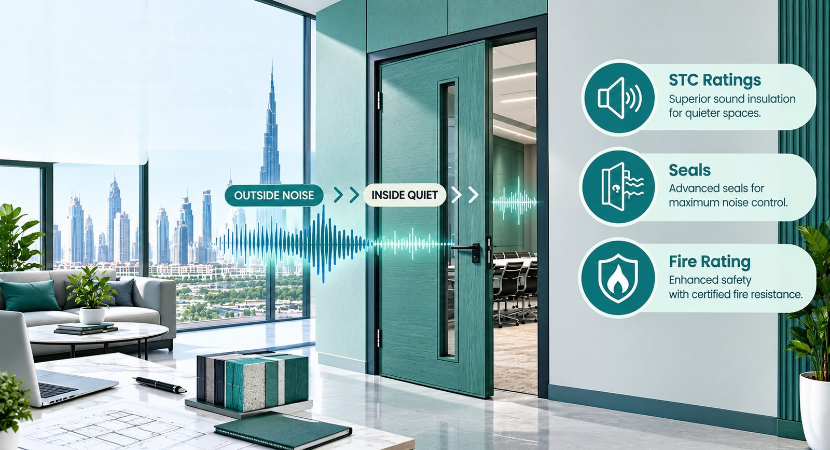
Choosing acoustic doors in Dubai starts with one fact: a door is usually the weakest point of any room. You can build a heavy, well-rated wall and still hear every conversation through a thin door with gaps around it. The decision comes down to four things: the STC rating you need, the core construction, the seals and frame, and whether the door must also carry a fire rating. As a rough guide, a standard hollow-core door sits in the low 20s to around 30 STC, a solid-core door in the low to mid 30s, and an engineered acoustic door with seals at 40 or more, while a pair of doors can reach about 40 to 48. That number only holds if the frame, seals, and installation match the tested assembly.
Anatomy of a Door Opening: Leaf, Frame, Seals, and Glass
A door opening is a system of parts, and sound takes the easiest route through whichever part is weakest. Looking at each part in turn explains why two doors with the same thickness can perform very differently.
The leaf and its core
The leaf is the moving panel, and its mass sets the upper limit of what the door can achieve. A hollow-core leaf, with a thin skin around a light honeycomb, is close to acoustically transparent. A solid-core leaf is much denser and typically lands in the low to mid 30s. Engineered acoustic leaves use layered, damped cores and can reach the 40s with proper seals. Moving from hollow to solid usually gains 5 to 10 points, and moving from solid to a sealed acoustic leaf can gain another 5 to 10.
The frame and the gaps around it
Mass only helps if air cannot bypass it. An opening equal to about 1% of the surface area limits the whole assembly to roughly 20 dB of reduction, 0.1% to about 30 dB, and 0.01% to about 40 dB. On a typical 2.1 m by 0.9 m door, a 3 mm gap all the way round is already close to 1% of the area. That single detail can cap performance near 20 dB, however heavy the core is.
Glass and vision panels
Glass is lighter than a solid leaf, so every vision panel lowers the rating, and a larger panel lowers it more. When a view through the door is genuinely needed, use laminated glass that was tested in that exact door and keep the panel small. If the room also has glazing facing a busy road, review the window-side options alongside the door so the weakest element on each side is addressed.
Reading Door Ratings Without Being Misled
Two doors with the same headline number can behave differently on site, because ratings come from different standards and different test conditions. A few checks make comparisons fair.
STC and Rw
STC (Sound Transmission Class) comes from laboratory testing to ASTM E90 and gives a single number for speech-range sound. Rw (weighted sound reduction index) is the international equivalent, based on ISO 10140 testing and rated under ISO 717-1. The two scales are close but not identical, so a data sheet quoting one should not be read as the other. Each 10-point step roughly halves how loud a sound seems.
A laboratory rating versus a real opening
The Steel Door Institute points out that the rating applies to the whole assembly, meaning the door, frame, and any glass, and that assemblies at STC 35 and above need careful attention to hardware, seals, and installation. Ratings are also published from either sealed-in-place or operable tests, and the operable figure is the more realistic one. On site, leaks around the perimeter can cost another 5 to 10 points, which is why a door that looked excellent on paper can disappoint.
What the numbers sound like
At STC 30 to 35, loud speech on the other side is still understood fairly well. At 35 to 40 it is heard but hardly intelligible, which is where real privacy begins. Between 40 and 50, loud speech is faint, and above 50, only loud sounds are faintly heard, if at all. Low-frequency sounds such as bass music pass through more easily than these descriptions suggest, so treat them as a guide for speech rather than a guarantee.
Matching Acoustic Doors in Dubai to the Room and the Wall
The right rating depends on what the room is used for and what surrounds the door. A higher number costs more and demands better installation, so it makes sense to specify what the space really needs.
Homes, villas, and apartments
For a bedroom or study inside a villa, STC 30 to 35 usually gives normal household privacy, and a solid-core leaf with perimeter seals can reach it. A door facing a shared corridor in a tower or serviced apartment is often specified at a minimum of about 32, with 35 to 40 giving a noticeable improvement. If a bedroom sits beside a media room or busy living area, aim higher.
Consultation rooms, meeting rooms, and media rooms
Spaces where confidentiality matters usually need a sealed acoustic door in the 38 to 45 range, and rooms such as a media or music room may need 40 to 45 or more depending on the wall. Where a single door cannot reach the target, a small lobby with two doors and an air gap between them performs better than one leaf of the same construction.
Why the door and the wall must agree
Sound reduction in a mixed wall is area-weighted, so the weaker element dominates. A 10 m² wall rated STC 50 that contains a 2 m² door rated STC 30 behaves like a wall of about 35. With an STC 40 door, the result rises to about 45, and with an STC 45, to about 48. Where the wall is one of the high-STC dividing walls, it is built for privacy; the door should come close to the same level, and where the door is a fixed limit, the wall can be designed around it.
Fire Certification and UAE Conditions
Doors in commercial buildings and many apartment blocks usually have to meet fire requirements as well as acoustic ones, and local climate affects how long the seals last. Both need to be planned before the door is chosen.
Fire and acoustic performance together
Many acoustic doors are also fire-rated, but the acoustic seals and the fire seals have to be designed as one system. Adding extra gaskets to a certified fire door later can invalidate its certification. Ask for a door that is certified for both, with documentation acceptable to Dubai Civil Defence for the building type.
Heat, humidity, and dust
Timber can move with strong changes in heat and humidity, and dust can foul seals and tracks over time. Choose finishes and gaskets suited to UAE conditions, and check that the manufacturer can support the product with spare seals and servicing. A local manufacturer and installer such as Airo Dyne can also supply, fit, and test the door, which keeps responsibility in one place.
Getting the Door Fitted So It Performs
A laboratory rating is a best case, and the finished opening only reaches it when the fitting is done carefully. Most of the gap between a data sheet and a real result is decided in the last few hours of work.
Frame fixing, sealant, and drop seals
The frame must be square and rigidly fixed, with the gap between frame and wall filled with acoustic sealant, and hollow steel frames are often grouted. Compression gaskets should run continuously at the corners, and an automatic drop seal should close the gap under the leaf without dragging on the floor. Good site fitting and sealing workmanship matters as much as the door itself, and a mock-up opening before full installation catches problems early. Avoid undercuts, grilles, and transfer vents in the leaf, because each one opens a direct sound path.
Testing the finished opening
For high-spec rooms, confirm the result with a field sound-reduction test, for example under ISO 16283-1, rather than relying on the data sheet. A test of the finished opening proves the rating on the actual site.
Documents to Request Before You Order
A short set of documents shows whether a door has really been tested for your situation. Ask for a laboratory report covering the complete assembly, including leaf, frame, seals, and glass, and check whether the rating is sealed-in-place or operable. Where a fire rating applies, request the fire certificate, and ask whether the finish and gaskets suit UAE conditions and whether replacement seals and a warranty are available. Keep third-party test documentation on file so it is ready for consultant and authority submissions.
