


Navigating Dubai Municipality Noise Regulations for Industrial Plant Rooms (2026 Guide)

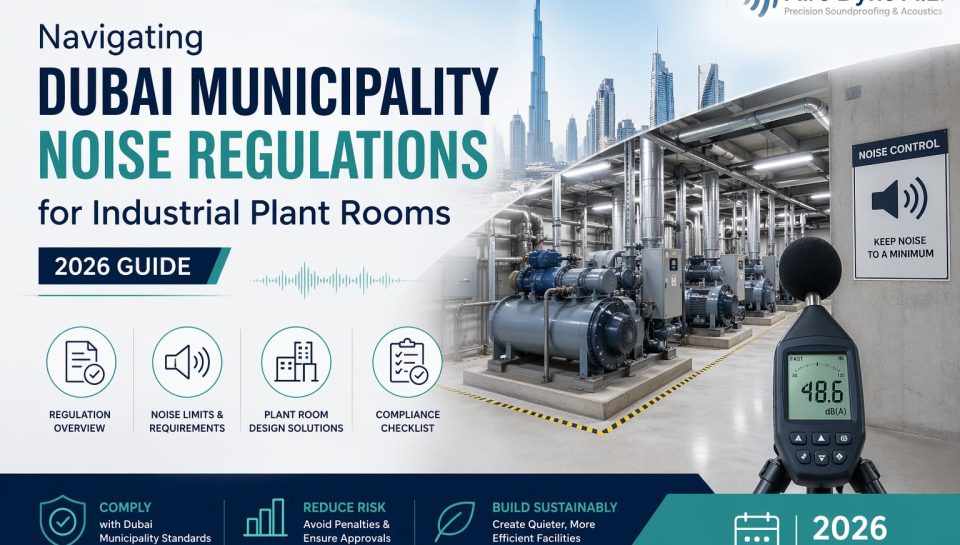
Compliance with Dubai Municipality noise regulations is essential for all industrial plant rooms operating within the Emirate. In early 2026, Dubai introduced landmark legislative changes—specifically Law No. (2) and Law No. (3) of 2026—to tighten the framework for urban and industrial sound emissions. For facility managers and building owners, understanding these evolving standards is the only way to ensure operational continuity without the risk of heavy fines. These laws reflect the city’s commitment to becoming the world’s most livable city by balancing industrial growth with environmental peace. This guide explores the specific requirements under these new laws and Technical Guideline No. 9, providing a comprehensive roadmap for achieving full compliance while avoiding legal penalties.
The New Landscape of Dubai Public Safety Laws (2026 Update)
March 2026 marked a significant shift in environmental and building standards across the UAE. Law No. (2) of 2026 has set new benchmarks for public safety, classifying excessive noise emissions as “auditory overexposure.” This law acknowledges that noise is not just a nuisance but a public health concern that can impact the productivity and well-being of residents. This places a heavier burden on industrial operators to contain sound within their facility boundaries to protect both workers and the surrounding community. Under this update, the responsibility for noise mitigation lies strictly with the facility owner, requiring them to invest in high-grade acoustic infrastructure to prevent sound leakage into neighboring residential or commercial districts.
Primary Regulatory Frameworks in the UAE
Noise control in the Emirate is governed by three primary frameworks that work in tandem to ensure a quiet urban environment. The Dubai Municipality (DM) Environment Department is responsible for monitoring ambient noise and enforcing specific decibel limits across different zones using advanced sensor technology. Law No. (3) of 2026 focuses on building quality and maintenance to ensure mechanical systems do not exceed noise thresholds as they age or undergo wear and tear. Finally, Federal Law No. 24 of 1999 remains against the overarching UAE environmental protection law that sets out the legal foundation for these local municipal standards. Together, these regulations create a strict legal environment where every industrial plant room must be designed with acoustic integrity in mind from the very beginning.
Permissible Noise Levels (dBA) in Dubai by Zone
The Dubai Municipality noise regulations classify permissible sound levels based on the “Receptor Area,” which refers to the type of land use adjacent to the noise source. Technical teams must identify their specific zone to ensure their project remains compliant with regional decibel limits throughout the day and night. Failure to meet these specific dBA targets can lead to immediate work suspension or the rejection of building permits. Because Dubai is a mix of high-density residential towers and industrial clusters, the transition zones are often the most strictly monitored areas. Building managers must conduct regular site surveys to ensure that the noise generated by their heavy machinery does not spill over into zones with lower permissible limits.
Decibel Limits for Different Land Uses
| Receptor Area Type | Daytime (7 AM – 8 PM) | Nighttime (8 PM – 7 AM) |
| Residential Areas | 40 – 50 dBA | 30 – 40 dBA |
| Commercial Areas | 55 – 65 dBA | 45 – 55 dBA |
| Industrial Areas | 60 – 70 dBA | 50 – 60 dBA |
Critical Compliance Requirements for Plant Rooms
To maintain a valid permit and pass municipality inspections, industrial plant rooms must adhere to specific technical requirements regarding ventilation, filtration, and soundproofing as per the Dubai Municipality noise regulations. These requirements are designed to address the fact that plant rooms often house the loudest equipment in a building, such as generators, chillers, and large-scale pumps. Simply closing the doors is no longer enough to meet the 2026 standards; instead, a multi-layered approach involving structural isolation and specialized air-path treatments is required. Facility managers must ensure that every opening in the plant room, whether for air intake or exhaust, is treated with a solution that balances the need for machinery cooling with the legal requirement for noise reduction.
Mandatory Installation of Acoustic Barriers
For rooms housing heavy generators, chillers, or massive AHU units, standard ventilation solutions are no longer sufficient to meet the new laws. Municipality consultants now mandate the use of a high-performance acoustic louver in Dubai to ensure that airflow requirements are met without allowing sound to bleed into neighboring areas. These barriers act as the first line of defense, reflecting and absorbing sound waves before they can escape the building’s envelope. By using materials with high Sound Transmission Class (STC) ratings, owners can significantly reduce the sound pressure level (SPL) at the property line. These barriers must be strategically placed to account for sound diffraction and the specific frequency profile of the equipment being used.
Engineering the Right Sound Attenuation
These systems are engineered to attenuate sound leakage through wall openings effectively while maintaining the operational efficiency of the machines inside. High-quality designs utilize aerodynamic blade profiles to reduce self-generated noise, ensuring that the barrier itself does not become a source of whistling or humming. The core of these systems consists of high-density acoustic infills protected by perforated sheets, which trap sound energy and convert it into negligible amounts of heat. This engineering approach is vital for plant rooms that require high volumes of air for cooling, as it allows for a “quiet” exchange of air that does not compromise the lifespan of the mechanical equipment or the comfort of the surrounding neighborhood.
Mandatory Noise Assessments and Certification
Under the 2026 regulations, buildings are required to obtain a quality and safety certificate that specifically includes noise compliance. This involves periodic acoustic testing conducted by licensed third-party engineering offices to prove that the facility is operating within the legal limits. Many operators rely on certified acoustic louver suppliers in the UAE to provide the documented lab test results, such as ASTM or ISO standards, required by DM inspectors during these audits. These certificates are not a one-time requirement; they must be renewed to prove that as machinery ages and potentially becomes louder, the acoustic measures in place are still performing at their original laboratory-tested levels.
Desert Climate Adaptations for Noise Control
Dubai’s environment poses unique challenges that can directly affect the performance of noise control systems over time. For facilities located in desert-adjacent zones, such as Jebel Ali or industrial clusters near the E311, a standard acoustic shield may fail if it becomes clogged with dust or sand. When an acoustic barrier gets filled with debris, its air-handling capacity drops, leading to equipment overheating and increased mechanical noise due to strain. Therefore, the 2026 guidelines suggest that acoustic solutions in these areas must be designed with the local climate in mind, using materials that resist corrosion from humidity and configurations that prevent the buildup of fine desert sand within the acoustic media.
Integrating Filtration with Noise Control Systems
Integrating a sand trap louver with your noise control system is essential for long-term operational success in the UAE. This multi-stage approach ensures that your mechanical equipment remains protected from the abrasive effects of sand while maintaining the necessary noise attenuation. By combining these two technologies, facility managers can achieve a dual-purpose solution that cleans the incoming air and silences the outgoing noise. This integration is particularly important for 24/7 operations where downtime for cleaning or repairs can lead to massive financial losses. Choosing a hybrid system that offers both filtration and sound absorption is now considered a best practice for high-value industrial assets in the region.
Penalties for Non-Compliance in Dubai
The authorities have introduced a tiered penalty system to ensure strict adherence to the Dubai Municipality noise regulations and the newly enacted Laws No. 2 and 3. These penalties are designed to be a strong deterrent, reflecting the seriousness with which the government views environmental quality. Initial fines can range from AED 500 for minor issues to AED 1 million for major industrial breaches, depending on the severity and the sensitivity of the location. Repeat violations can see these fines escalate up to AED 2 million for persistent offenders within a single year. Perhaps most critically, the municipality reserves the right to suspend building completion certificates (BCC) or operational licenses until a compliant acoustic report is filed and verified.
Conclusion Engineering a Silent Future
As Dubai continues to evolve into a world-class hub, noise mitigation has become a hallmark of quality construction and responsible facility management. By partnering with specialist firms like Airo Dyne, developers and building owners can implement certified acoustic solutions that ensure long-term compliance with the current legal landscape. Investing in laboratory-tested products—from high-density panels to hybrid louver systems—is the only way to avoid legal risks and enhance the overall value and sustainability of the project. In the competitive Dubai real estate and industrial market, a quiet and compliant facility is not just a legal requirement but a significant asset that demonstrates professional excellence and care for the urban environment.
